
Picture this: imagine walking into a high-end car dealership.
You find a sports car that looks absolutely pristine on the showroom floor. The paint is flawless, the leather seats are perfect, and the dashboard looks like a piece of cutting-edge technology. You sit in the driver’s seat, wrap your hands around the steering wheel, and listen to the salesperson list off the incredible horsepower and mechanical specifications of the engine.
First reaction? You’re sold.
But when you turn the key, nothing happens. Underneath the hood, there are no wires connecting the ignition to the engine. The car looks spectacular, but it is completely incapable of moving an inch. It’s a beautiful shell with zero operational power.
Second reaction? You’re definitely not buying this car.
Consider this question honestly without judgement towards yourself: Are you entering the next season of life with a faith that might be a little similar to that showroom car?
Maybe you’ve spent years sitting in pews, attending youth groups, and accumulating theological information. You know the right vocabulary, they can recite the right verses.
You definitely know when it’s the right moment to yell “Jesus!” as the answer to the Sunday school question.
You’ve got the Christian childhood on lock. But what happens when you enter Christian adulthood?
Often the independent, fast-paced environment of university life, can expose a disconnect. Maybe your internal convictions have no wiring connecting them to your daily habits, private choices, or public interactions.
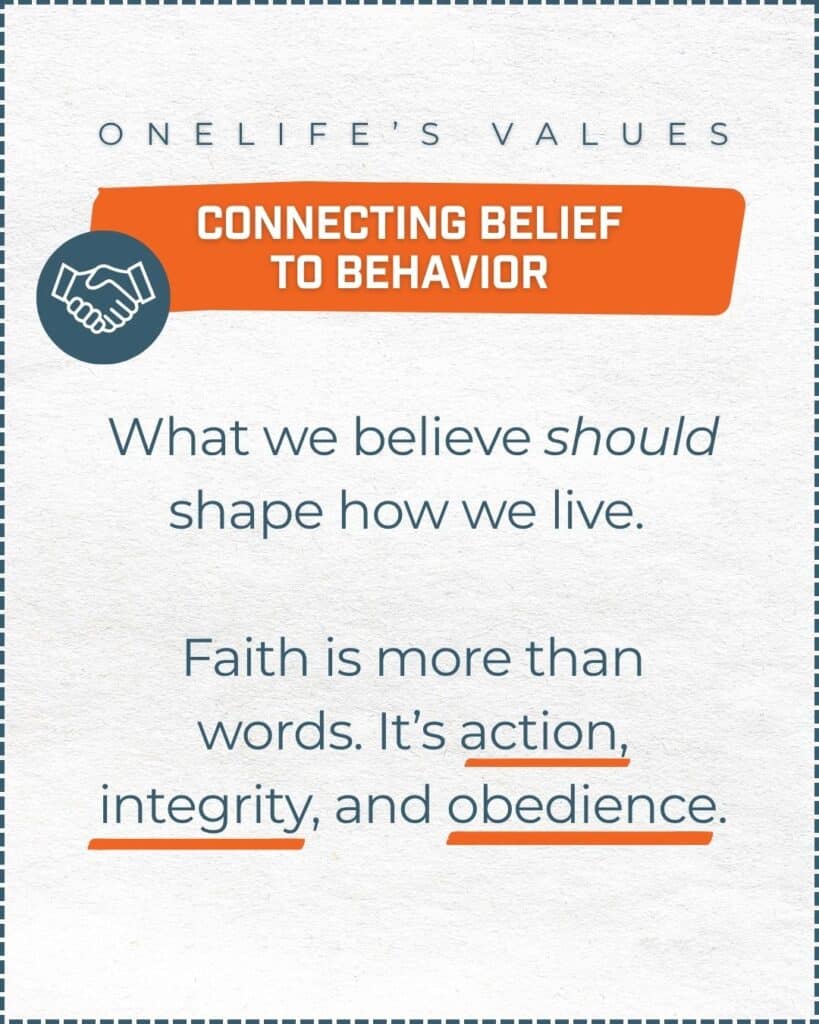
The second core value in our series is a direct challenge to the spectator Christianity of our culture: Connect belief to behavior.
The Uselessness of Abstract Conviction
To put it bluntly, a belief that doesn’t affect your living is useless at best and hypocrisy at worst.
It is incredibly easy to agree with Christian theology in a classroom where you are surrounded by people who think exactly like you do. It takes zero courage to nod your head during a sermon about humility or love.
But if that agreement doesn’t fundamentally change how you handle conflict in your dorm room, how you manage your schedule, or what you look at on your phone when you are completely alone, then it isn’t actually a belief. It is just an opinion.
It’s worth asking: if what we believe never affects how we live, do we really believe it?
Jesus addressed this exact issue with terrifying clarity at the conclusion of His most famous message. In Luke 6:46, He asks a penetrating question that every high school graduate needs to wrestle with: “Why do you call me, ‘Lord, Lord,’ and do not do what I say?”
Yikes…
I can imagine just how uncomfortable that made those he was talking to. I know I would’ve been!
He goes on to describe two different kinds of builders. The one who hears His words and puts them into action is like a wise builder who digs deep and lays a foundation on solid rock. When the torrent breaks against that house, it stands firm because it is well-built. But the one who hears His words and fails to connect them to their behavior is like a foolish builder who builds on a foundation of sand. The moment the storm hits, the collapse is immediate and catastrophic.
The modern university campus is a spiritual storm. To keep your faith from buckling under the pressure, it’s necessary to enter that environment with a faith built on more than intellectual information.
Outcome 1: Developing Christian Character in Real Time
So, what does it actually look like when your beliefs begin to direct your behavior? At OneLife, we track this transformation through three interrelated outcomes. The first is developing Christian character.
True Christian character is not something you can manufacture through sheer willpower or by pretending to have it all together. It is developed over time as you learn to listen to the Holy Spirit’s guidance and actively allow God to shape you to be more Christlike. Character isn’t an abstract concept; it is a visible fruit. It shows up practically in the form of love, joy, peace, patience, kindness, goodness, faithfulness, gentleness, and self-control (Galatians 5:22-23). It is forged through biblical virtues like courage, humility, hospitality, and selflessness.
During a dedicated growth year, like a gap year, your character is pulled out of the textbook and tested in real time. When you are…
- waking up early for a group ministry project,
- navigating a difficult wilderness backpacking trail,
- or sharing a living space with people who have completely different personalities than yours,
you are forced to choose. Will you let your natural selfishness run the show, or will you connect your belief in Christ’s love to your behavior toward your cohort?
By practicing these virtues daily within a supportive environment, they stop being theories you memorize and start becoming the natural rhythm of your identity.
Outcome 2: Clarifying a Biblical Sense of Calling
The second outcome tied directly to this core value is clarifying a biblical sense of calling. Right now, you are probably feeling an immense amount of pressure to figure out your career path. You’re being asked what you want to major in, where you want to work, and how you plan to make a living.
But at our gap year program, we believe that your personal calling only becomes clearer when you are first faithful to the universal calling of all Jesus-disciples: to seek His kingdom and His righteousness above everything else.
Calling is discovering both who you are to be AND what you are to do.
Crucially, the doing must always flow from your being. If you try to select a career before you have allowed God to anchor your character, you are setting yourself up to chase cultural success at the expense of your soul.
When you connect belief to behavior, you stop looking at your future through a passive lens of “What job will make me the most money or give me the most status?” Instead, you begin to seek His kingdom within the context of a real community. You move from guessing a career path to owning a kingdom vocation.
Outcome 3: Growing in Relational Wisdom
The final outcome that emerges when you bridge the gap between conviction and action is growing in relational wisdom. Relational wisdom is simply having an appropriate, Spirit-led awareness and engagement with God, yourself, and others.
It means being able to step out of your own head, exercise discernment about what a specific moment requires, and then act accordingly. It means showing up to a conversation with the character of Christ and the humility of your calling, rather than reacting out of emotion, insecurity, or selfishness.
High school graduation opens the door to total independence, which can be an incredibly messy and confusing transition if you don’t know how to navigate relationships wisely. If your faith is purely intellectual, you will struggle to handle roommate conflicts, navigate peer pressure, or build deep, unconditional friendships when you leave home.
But when you commit to connecting your beliefs to your behavior, you begin to look at every interaction as a discipleship opportunity. You learn how to listen well, how to extend and receive forgiveness, how to manage biblical conflict resolution, and how to love people even when it is challenging. Relational wisdom is where your theology meets reality.
Moving From Intention to Action
If you are tired of merely agreeing with truth in your head while feeling stuck in your daily habits, it’s time to step into a different rhythm. Trade a spectator faith for an operational one.
The journey toward becoming a dedicated follower of Christ doesn’t happen overnight. It happens one day, one habit, and one intentional choice at a time.
Here are some questions to ponder…
- Where is my life currently reflecting a disconnect between what I say I believe and how I actually live?
- If someone looked only at my daily calendar and habits, what would they say my deepest convictions are?
- What is one practical area of my life, a relationship, a habit, or a choice, where I can practice immediate obedience today?
Something to consider…
If those questions feel challenging, you’re not alone.
At OneLife, our gap year program is specifically designed to help you bridge that gap. During this intentional season, we want to help you find your vocation and clarify your calling by exploring how your unique passions, gifts, and personality align with God’s purpose.
If you’re ready to connect your belief to your behavior, we are ready to welcome you into a community that will challenge you and cheer you on every single step of the way. Start your free online application today.
Values Series – #2: Belief to Behavior
Check out our post from last week in our Values Series – #1: Kaizen
Stay tuned for our post coming next week in our Values Series – #3: Attitude of Gratitude!