

Let’s be entirely honest about what it feels like to navigate the transition out of high school right now…
It can feel like total sensory overload.
On any given day, you are likely balancing the stress of major life decisions, navigating shifting friendships, dealing with family expectations, and trying to figure out your next steps.
Another layer? Add in a constant stream of social media updates showing everyone else apparently living their absolute best lives, and it’s incredibly easy to slide into a state of quiet comparison and chronic frustration.
When life feels like a constant grind, our natural default setting is to focus entirely on what is going wrong.
Before you know it, you’re looking at your life through a lens of scarcity. And let me tell you from personal experience, a scarcity mindset is no fun.
You start believing that you’ll finally be happy after you survive this semester, after you get into the right university, or after you figure out your exact career path.
Yeesh…that’s a lot of waiting…
But what if the joy you are looking for isn’t waiting for you at the destination?
What if it’s something you can experience right now, right in the middle of the mess?
Use these 4 practical steps as a guide…
- Step 1: Challenge Your Default Settings
- Step 2: Find Your Anchor When Life Feels Chaotic
- Step 3: Create New Mental Pathways
- Step 4: Don’t Just Think It, Practice It
Step 1: Challenge Your Default Settings
Gratitude is a word that gets thrown around a lot right now.
You see it on aesthetic journal covers, in wellness podcasts, and across social media feeds as a trendy self-care habit.
For a follower of Jesus, an attitude of gratitude is far more than a positive vibe. It is a radical choice to change your entire framework for looking at your life.
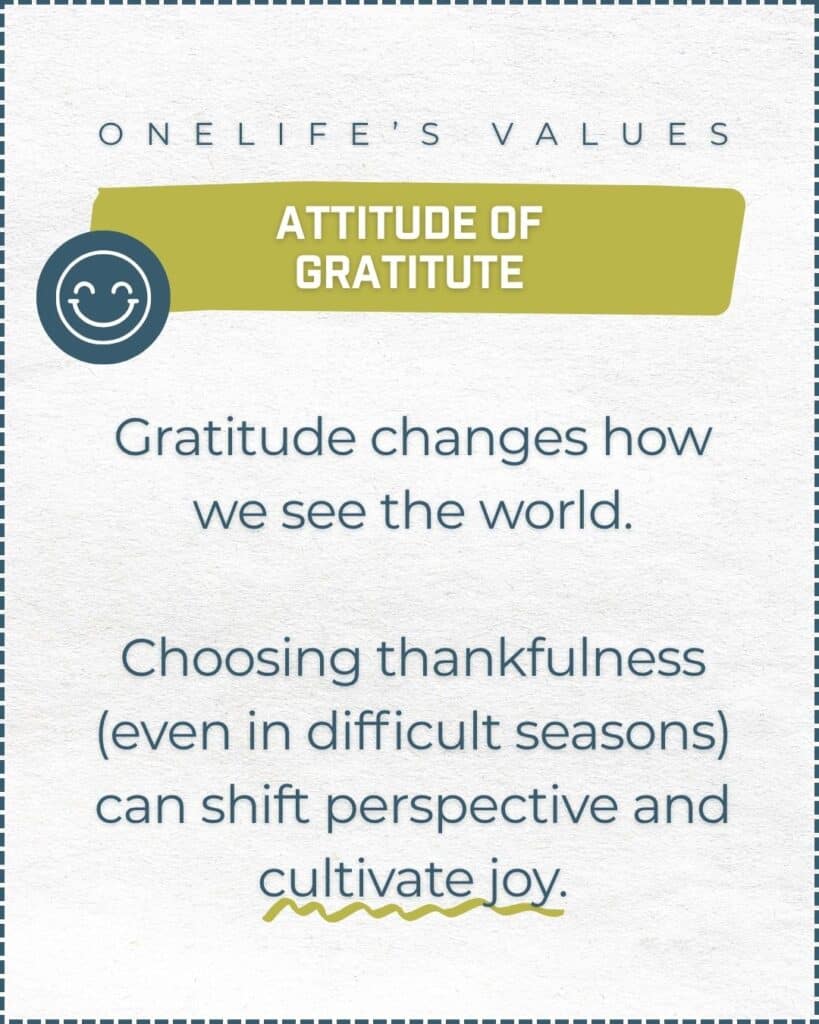
Practicing gratitude has the power to cultivate real joy and completely shift your perspective. It moves you from focusing on what you lack to recognizing what you’ve been given.
But let’s clear up a major misconception right now: You don’t have to be grateful for everything.
The Bible never commands you to pretend that painful, frustrating, or broken things are secretly great. Just skim through Job, Lamentations, and many of the Psalms…the authors weren’t exactly known for bottling up their frustration and putting on a happy face. And for the record, that was not wrong, God didn’t shut down their pain. He acknowledged it and met them because He wants us as we are.
If you are dealing with a difficult family situation, feeling lonely in a crowded room, or processing a painful disappointment, you don’t have to put on a fake smile and pretend everything is fine.
That isn’t faith,and it honestly just feels fake.
Which in turn can lead to feeling even more loneliness. And I don’t want that for you.
The actual biblical invitation is completely different: You can be grateful in everything.
There is a massive difference between being grateful for a situation and being grateful in a situation.
You don’t have to be grateful for everything, but you can be grateful in everything.
Being grateful in everything means that even when the circumstances around you are messy, chaotic, or confusing, you can anchor your mind in the unchanging goodness, presence, and grace of God.
Step 2: Find Your Anchor When Life Feels Chaotic
This call to a grateful perspective is woven into the very fabric of the New Testament.
The writers of Scripture didn’t look at gratitude as an optional bonus for extra-spiritual Christians; they looked at it as a baseline necessity for a healthy life.
Consider how the Apostle Paul connects gratitude to our daily walking orders in Colossians 2:6-7: “So then, just as you received Christ Jesus as Lord, continue to live your lives in him, rooted and built up in him, strengthened in the faith as you were taught, and overflowing with thankfulness.”
Notice the progression here. True spiritual strength results in a life that is overflowing with thankfulness.
Paul doubles down on this rhythm in 1 Thessalonians 5:16-18 with instructions that sound incredibly simple but require a lifetime of practice: “Rejoice always, pray continually, give thanks in all circumstances; for this is God’s will for you in Christ Jesus.”
Again, the text doesn’t say give thanks for all circumstances, but in them.
Why? Because as James 1:17 reminds us, every good and perfect gift comes from a Father who does not change.
When your world feels unpredictable and your future feels unclear, gratitude forces you to look up at the Father who is unchanging. Which I don’t know about you, but that gives me a lot of peace.
Step 3: Create New Mental Pathways
So, how do we actually practice this in daily life? It starts by breaking the habit of running on autopilot. It is incredibly easy to let our minds drift into chronic complaining. We complain about the weather, the food, the schedule, or the people around us without even realizing we are doing it.
Gratitude requires a thoughtful mind. It requires you to be an active problem solver who intentionally hunts for the good, even when it’s hidden beneath a challenging day.
I gotta pause to geek out on God’s genius here for a second…
There’s tons of research that shows when we stop our negative thought patterns in their tracks and instead invite gratitude we create new neuron pathways in our brain.
God has created our brains in a way that when we look for His gifts in the ordinary, everyday moments, our entire brain changes.
Over time, we stop waiting for a massive, dramatic miracle to happen before we decide to be joyful. Instead, we find joy in the simple things:
- a great conversation with a friend
- a beautiful sunrise
- an encouraging word from a mentor
- or the simple fact that you have clean water and a place to sleep.
By making the daily choice to notice and name these gifts, you train your brain to see the world through a lens of abundance and grace.
Step 4: Don’t Just Think It, Practice It
If you are tired of feeling drained by comparison and weary of the constant pressure to find joy in your circumstances, it’s time to step into a different rhythm.
The journey toward becoming a dedicated follower of Christ doesn’t happen overnight. It happens one day, one habit, and one intentional choice at a time.
Here’s some SUPER PRACTICAL ways you can do this:
- Text someone and tell them specifically why you appreciate them. Not a vague “love ya,” but “I was thinking today about how you always show up for me.”
- Keep a “proof God was here” note on your phone. Add one thing whenever you notice God’s provision, kindness, or faithfulness.
- End your day with three good things. Before scrolling yourself to sleep, name three things you’re grateful for from the last 24 hours.
- Practice the “and” mindset. “Today was stressful and I’m grateful for the people who helped me through it.” Gratitude doesn’t require denying reality.
- Celebrate small wins. Finished an assignment? Made it to the gym? Had a hard conversation? Pause long enough to acknowledge it.
- Write down one thing you’re looking forward to. Gratitude isn’t only about the past, it can also be hopeful anticipation for what’s ahead.
Something to consider…
Don’t do this alone. Community is necessary.
We’ve seen firsthand how coming alongside our gap year students to personally show them how to practice gratitude in the midst of hardship is what makes it stick. We’ve helped them wrestle with balancing the “both/and” of life is messy and painful AND God is good.
If that’s something you want to learn alongside others with intentional coaching from our staff, we’d love to have you join us at OneLife!
Values Series – #3: Attitude of Gratitude
Check out our past Values Series posts – #1: Kaizen & #2: Connecting Belief to Behavior
Stay tuned for our post coming next week in our Values Series – #4: Be Comfortable with the Uncomfortable!